Last year, everything changed for Mike Shinoda. With his debut solo album under his own name out now, he's finding catharsis in music.
Words: Ali Shutler.
"There's a vast, unexplored road in front of me," admits Mike Shinoda. Last year, he lost one of his best friends to suicide, and it changed his world. His debut record, ‘Post Traumatic' deals with that loss and the journey that follows.
It's personal, as all grief is, but it also taps into something bigger. See, Chester Bennington meant a lot to Mike, but he also meant a lot to the world at large. As the twin peaks of Linkin Park, the pair had worked side by side for almost twenty years, becoming one of the biggest, and most successful rock bands in the world across a legacy of seven albums, countless world tours and a connection with the people who were listening.
Linkin Park changed the game time and time again while standing for something real, vulnerable and important.
The loss of Chester was felt around the world; people had lost a hero, a role model and someone who they felt understood them. Mike though, he'd lost family. He lost purpose, too. For almost half his life he had been 'Mike Shinoda from Linkin Park'. Now, he wasn't so sure.
Initially, Mike didn't know what to do. His usual method of dealing with emotion was to get into the studio and use it to create, but now it scared him. For nine days he let that fear control him until he decided to face it head-on. At first he just started playing around, creating for creation's sake, but eventually, the music he enjoyed began to appear.
That's what ‘Post Traumatic' is; snapshots of what happened next, as Mike comes to terms with the past and looks to the future. Right now, he's in LA, putting the finishing touches to the record and talking about the weather.
"I'm doing pretty good; I'm in the finishing stages. We're starting to get the mixes, we're getting into the rest of the record in terms of finishing, and I've got maybe a song or two left to do. One song that's 90% done and there's another song that's maybe 75 or 80% done, and the rest is finished. It's close.
It's the same in England, as London gets its first real taste of warm weather.
Mike talks about his experiences without a filter, and when he can't find the words or words just won't do, he uses stories to mirror his own journey. From the opening steps of ‘Place To Start' and on into the unknown, everything about ‘Post Traumatic' finds him facing the world head-on.
"At some point I got curious, and I looked up other artists and other bands that went through a similar situation that I went through. I looked at what they did next. How soon did they play music, play live, or write or release an album?
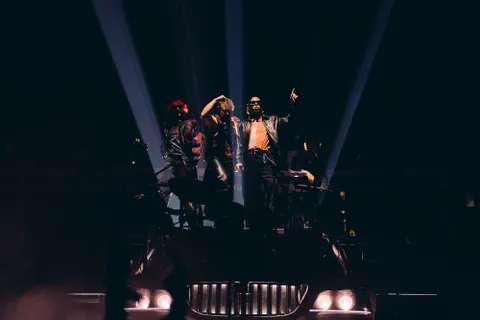
It's not like Linkin Park found themselves alone though. Their tribute concert to Chester at The Hollywood Bowl saw everyone from Bring Me The Horizon's Oli Sykes, A Day To Remember's Jeremy McKinnon, and blink-182 share the stage with Alanis Morissette, Daron Malakian and Shavo Odadjian from System Of A Down and M. Shadows from Avenged Sevenfold.
"The primary focus was honouring Chester and giving the fans a memorial event for him and for them. We know lots of people that sing, and they're great, but we got onstage at the Hollywood Bowl, sang a lot of songs with a lot of people, and, after we got offstage and in the week after, I was reflecting on the show that had happened. I was thinking god, all those singers were great, and none of them were Chester.
In making this record, in touring it, in sharing it, there's a hope that Mike will find the answers he currently doesn't have.
"I don't know if I could have done anything else," he continues. "The only other things that occurred to me were, I love writing with other people, and I'd be happy to produce people's albums or write with other artists, and I love to paint, and I'd have loved to have done some gallery art shows.
From the 'Post-Traumatic' EP, the first solo songs Mike shared alongside shaky, home studio footage for ‘Crossing The Line' and ‘About You‘. They were just as intimate and confronting as the ongoing conversations he was having online and in person.
"I'm trying to be more open about how things are going. Inevitably, I have to talk about it in interviews and talk about it with fans, and I'll have to get onstage and play these new songs and our old stuff too.
"One of the things I was most nervous about was seeing fans on my own," he continues. "I would be singularly responsible when they come up and start talking about Chester, crying or asking me questions or whatever. I would be responsible for having those conversations.
On 'Post Traumatic', Mike tries to repay it in kind.
If you're reading this magazine, Chester's death probably affected you. It affected us. It was almost impossible to put into words just how deeply, but knowing you weren't alone in that confusion, that loss, made it a little easier.
"For better or worse, it's my job to put those things into words," says Mike with a half smile. "I found that my take on everything changes slightly from time to time. The community around Alcoholics Anonymous, not the actual group but the support network for friends and family, it often teaches that being an enabler is part of the problem, but you're not responsible for the person's actions. You can do what you can to help but only within the boundaries. You can only help if you're also protecting and loving yourself, right.
"Being in my situation and taking a cue from that, I have my own issues and struggles to deal with. I have at some point felt compelled to respond to people who are in obvious trouble on Twitter, but I have to remind myself that, that's not helpful. It's not good for them; it's not good for me. I can't solve their problems, all I can do is provide an example of what I'm doing on my own path towards figuring it out.
"It's everyone's responsibility to look at their own shit and figure out what the best way to deal with it is. We've all got our own shit," he adds. "But, by the way, I'm also a human being. I see somebody hurting, and I want to do something.
The record places a heavy weight on talking. Across his back catalogue, Mike has shared himself with the world, but on ‘Post Traumatic', it's the act of conversation that feels important, not the outcome. He shares his own journey, the good days and the bad, without fear of judgement and encourages people to go on their own, because they won't be alone in it.
‘Over Again' was written and recorded the days either side of the Hollywood Bowl tribute show and finds Mike at war with himself and those feelings of right and wrong. There's a flickering of anger directed out at the world that he's found himself in this impossible situation. It's not pretty, but it is raw, unfiltered and honest. From the get-go, there's no hiding. There's no standing still either.
‘Crossing The Line' feels like a fresh start. Capturing fears about telling his Linkin Park bandmates about his need to do something by himself and admitting, "I got demons inside me, so I'm faced with a choice. Either try to ignore them, or I give them a voice." The song bursts with new beginnings and breaking dawns as Mike puts one foot in front of the other. Filmed on the Sunset Strip in West Hollywood, it's the same location that Linkin Park played their first ever-public show in 1998. New dawns don't mean yesterday is forgotten.
"The album goes from a dark place to a brighter place and ‘Crossing A Line' is actually the middle of the album," explains Mike. "It gives you a sense of the transition from not wanting to leave my fucking house to getting back to being part of society again. There was a month or so where I was having to go back out into the world and being okay with that.
"In the beginning, I didn't want to leave my house and go to lunch because it was just too scary. People would come up to me, ‘Oh man, I'm so sorry to hear what happened', and I'd be getting into these horrible conversations with strangers. Every single human being in my life, every friend, every family member, we'd have to dive straight into the subject that everyone was thinking about.
"I had a situation where I went out to lunch for the first time since Chester passed away and I'm coming back to my car with my wife thinking, 'That went well; I can do this'. But fucking paparazzi are stood by my fucking car shooting pictures of us and asking stupid fucking questions. And it was miserable.
"I told them they should be ashamed of themselves, and they just stared at me with these blank, sad faces ‘cos they knew they had done something wrong, but that's their job. But what a horrible job and what a horrible place to be, right? It just made it harder for me to just go about my life.
"At a certain point, I just had to face enough of that and be okay with it," he considers. "I had to listen to our music, for example. I was in a car on a long drive back from Phoenix's house , and we were hanging out with all the guys in the band, and he'd asked, ‘Have you guys tried to listen to our music yet?' Everyone said no.
"As I was driving home that night, I listened to our music. It was hard, but it was something I could strike off my list of things I had done again.
Mike Shinoda has done solo albums before. His Fort Minor project released ‘The Rising Tied' in 2005 as a place for him to explore his hip-hop influences before they were welcomed fully into Linkin Park. Then, in 2015, he released the one-stop single ‘Welcome' as an excuse to step away from the arenas LP were playing with their ‘The Hunting Party' album and reconnect with fans, b-sides and spontaneity.
For a moment, it felt like anything could happen. And that's how it feels leaning into Mike Shinoda's first proper solo album.
"I had no concerns about being able to make an album," he shares. "I do that for Linkin Park every time. I'm behind the steering wheel of that ship, I know I can do anything sonically. I can do anything I want to do. In terms of the craftsmanship and the process, it's not a problem. It's the opposite; it's one of my favourite things.
He'd wanted to do something solo post-‘One More Light' anyway, but this record, it's under his name. A sign that this is intimate, personal but also new, exciting and without expectations. A clean slate as new beginnings twist out of unexpected ends. After what he'd been through, he needed that freedom. He needed that control.
"It's a massive factor. Any time you go through something traumatic or stressful, one of the worst human emotions is feeling out of control. That extends from a girl not wanting to go out on a date with you, to your parents' expectations that don't line up with what you want," he starts.
"I was just in China, and I stumbled upon Matchmakers Corner, at this park in the middle of Shanghai. It's where parents go to negotiate arranged marriages for their children. The children aren't even there, and the parents don't even have pictures. They just have descriptions and information like monthly income and what kinda car they drive, and it was so foreign to me, but it does come back to that feeling of control.
"I've been through this thing, and I just felt like I had absolutely no control. I didn't even have control over who I was. To some degree, my identity was in danger of being taken away from me. That was the worst feeling.
"So, in doing this record, getting through this whole thing and being able to have an idea for a video and then in six hours, be out shooting it - I can literally make a decision and go do it. I don't have to ask anyone else. For me, that's crazy. I've never had that. I've always had to bring it up to other people.
"In Linkin Park, if we were to decide on a show or a song, every step of the way, I'd be in conference with five other guys, talking about the pros and con. This goes for every decision we ever make. People that have worked with us before have said it's incredible how far we got having six CEOs. No business can have six leaders, and it's hard for a band to be a democracy.
As you would expect from someone with a back catalogue as varied as Mike's, ‘Post Traumatic' isn't predictable or stays in one lane.
"There ended up being a lot of variety on it. We did a few albums with Rick Rubin, and at one point, we ended up talking about Public Enemy. I grew up on that band, I love them, and we were talking about how Chuck D, to some degree, was Public Enemy, but you could never have Public Enemy without Flavor Flav.
"Chuck was the super political hardcore rapper, and Flava Fav was the court jester who kept things fun and cracked a joke at just the right moment. He kept things silly, and that's important. People need a break when they're dealing with something heavy.
On 'Post Traumatic', Mike Shinoda wants to be heard. Beyond sharing the music, doing interviews and releasing the album properly instead of dropping eight tracks for free on 1st January 2018 - which was the plan at one point - he's also playing huge shows this summer at festivals around the world. Writing and recording the music has been therapeutic to him, now it's time to show others the way.
Taken from the June 2018 edition of Upset. Mike Shinoda's album 'Post Traumatic' is out 15th June.