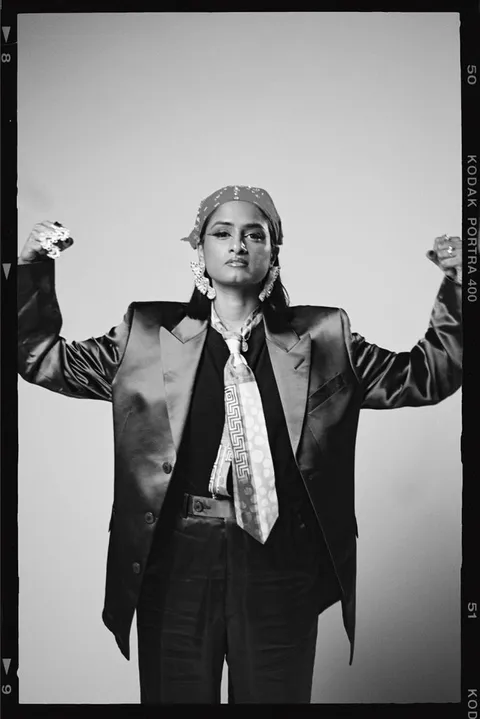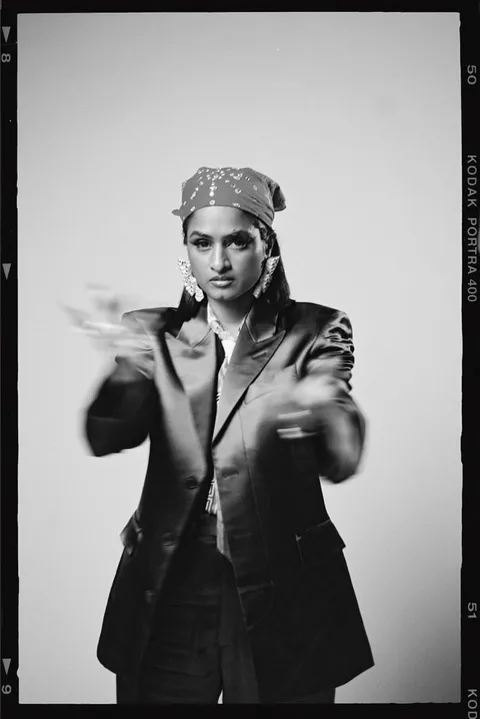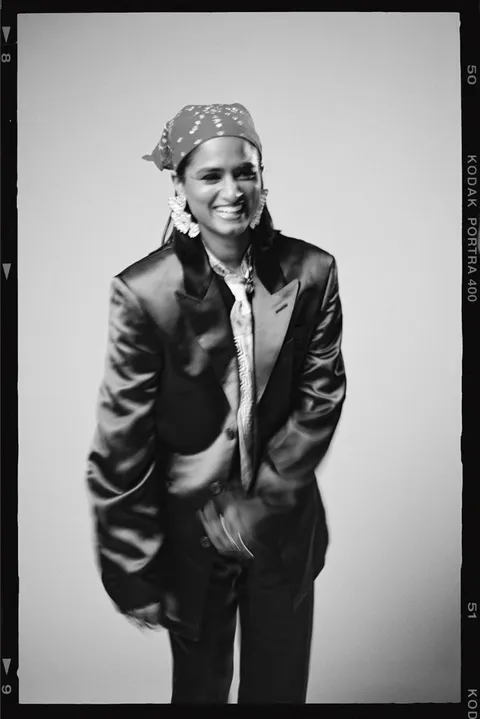


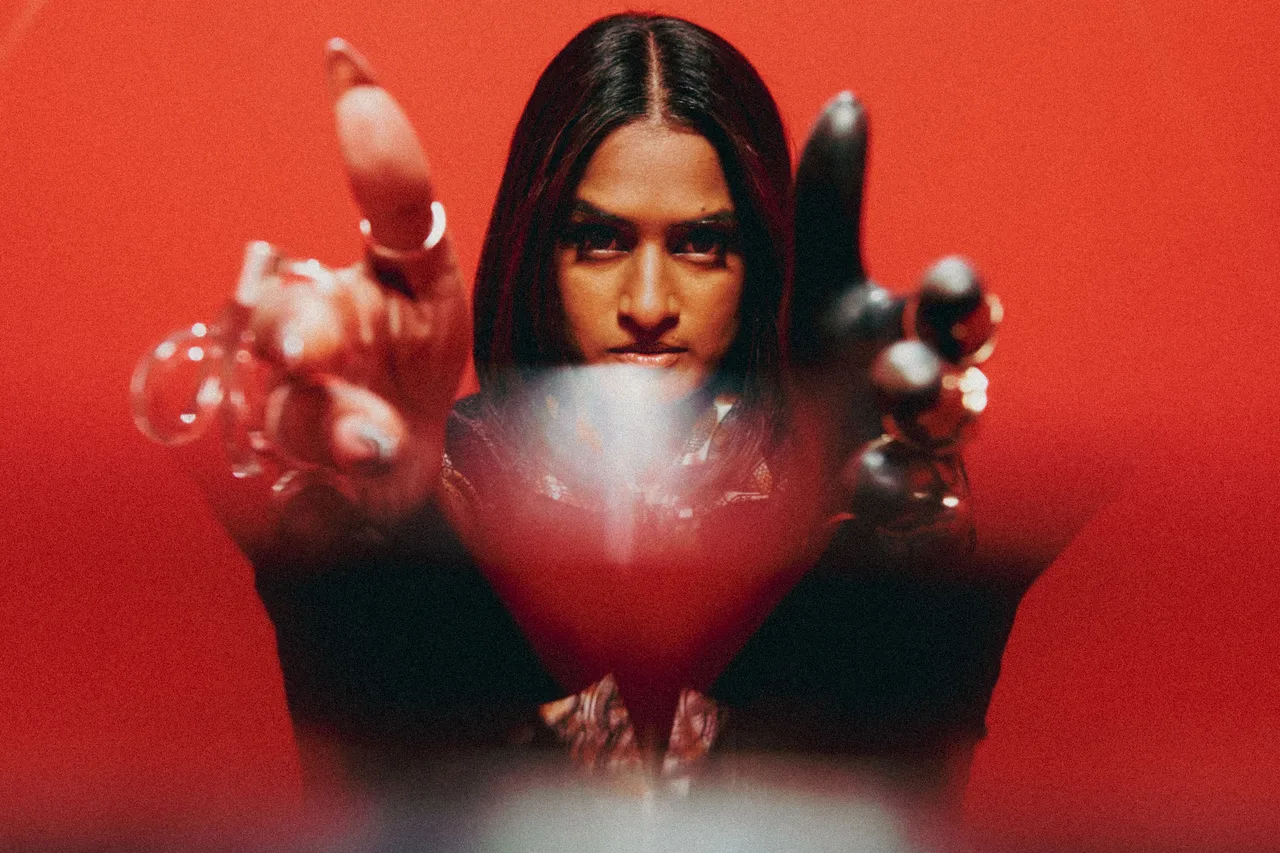
Priya Ragu is bringing “raguwave” to the masses with her joyous debut album, ‘Santhosam’.

Priya Ragu is bringing “raguwave” to the masses with her joyous debut album, ‘Santhosam’.
PRIYA RAGU is bringing “raguwave” to the masses with her joyous debut album, ‘Santhosam’.
Words: Ali Shutler.
Priya Ragu's debut album is full of bangers. Opening with 'Ammama's Note', a voicemail from her grandmother asking why she's not married yet, the record quickly slides into the joyful 'School Me Like That' which celebrates leaps of faith and her own "raguwave" genre before the disco-inspired 'One Way Ticket' and a hammering 'Hit The Bucket' keep the party going. "I'm fully convinced about this record," Priya says. "I guess I could do a few more social media posts about it, but apart from that, I've done everything that I could. This is me. This is the sound that I always wanted to create."
Created over an 18-month period between tour dates with producer/collaborator/brother Japhna Gold, it's a record that follows intuition and positive vibes. Priya had no grand vision for what her debut album would look like, but one by one, the pair created songs that felt good, and it eventually just made sense, says Priya. "Initially, I thought it was going to be a lot of love songs, but it ended up telling a story of me finding my own happiness through this journey." It's why it's called 'Santhosam', which means happiness in the South Asian language of Tamil.
Priya Ragu seemingly appeared from nowhere in 2021 with the sleek swagger of 'Good Love 2.0' and the following mixtape 'damnshetamil' only underlined her pop star potential. "It's familiar, but it also completely switches things up and offers something new," explains Priya of why her early music connected.
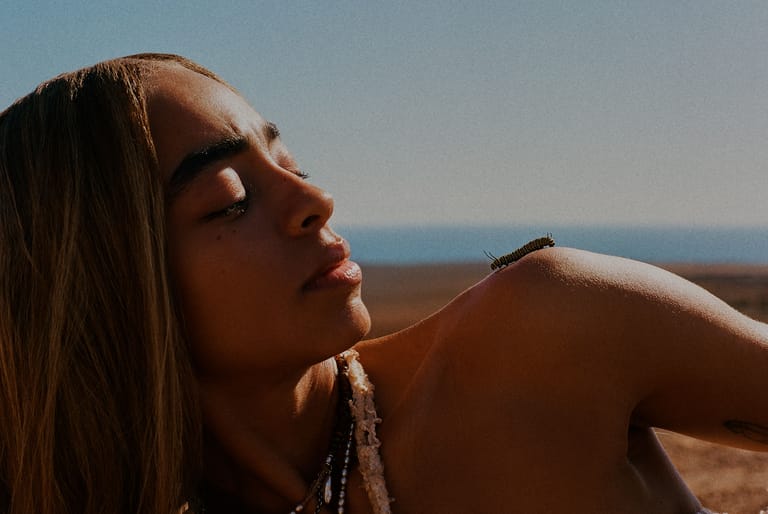
"I guess I could do a few more social media posts about it, but apart from that, I've done everything that I could"
— Priya ragu
Growing up, Priya was involved in communal jam sessions organised by her parents, who had relocated to the Swiss city of St Gallen following the Sri Lankan civil war, but they weren't so keen on her newfound love of R&B. Forced to follow her passion in private, she went on to work for Swiss International Air Lines as a technical buyer to make them happy, and would occasionally do an open-mic night or sing backup for friends on the side. After a decade of compromise, she turned to her brother Japhna to start working on original music together. To start with, Priya wasn't sure about introducing South Asian influences to her sound, "but that just felt like the real me," she explains. "Who cares if radio stations didn't get it?"
Just before releasing 'Good Love 2.0', she told the universe, "'Look, this is the song, and it's in your hands to bring it to the right people'. And it really did," she grins, but her ambitions didn't really go beyond the act of releasing music. "I wasn't thinking any bigger," she explains.
However, 'Good Love 2.0' inspired an instant reaction when it was released, and the rest of the mixtape was put out by Warner Records UK, home of Griff, Thomas Headon and PinkPantheress. "It felt like my music connected with people straight away as well, which was really beautiful but very surreal," she explains, with her self-described Raguwave cutting sleek, stylish R&B with her own Sri Lankan heritage. "I never made music for anyone else, though. I made those songs for myself, I liked them, and I wanted to share them. It was validating to be accepted for who I am."


She knows she's still one of the few Asian women in pop, "so I take that as a big responsibility". Still, there was no pressure when it came to 'Santhosam'. "There shouldn't be that pressure if you're just being authentic, but it's nice to see young people inspired by the music I make or the things I do."
"I always felt like the mixtape was a great beginning," she continues. "It gave me a direction," with 'Santhosam' seeing her confidently continue down that path. "I just wanted to make good music. The album is sonically in the same realm as the mixtape, but everything sounds fresher," she continues, saying you can hear the better quality mics they had access to. "It wasn't about proving anything to anybody, though. I just wanted to explore and see what else I was capable of. I'm very satisfied with what we got," she says.
Inspired by the months of touring that came alongside her mixtape, 'Santhosam' is more upbeat and more deliberate than her previous work. "It's more fun to play uptempo songs, and I knew it would be more joyful to write lyrics that had more affirmation in them. It was important to have positive songs," she says, explaining how the world needs those bursts of optimism right now. "It can never be enough."
The twitching 'Power' came about after a bout of feeling uninspired. Jephna sat behind the drums, Priya picked up a bass, and it quickly started taking shape. "Sometimes the smallest spark can turn into something great," she explains, describing the track as a superhero anthem. "Do we have a sync with the next Marvel movie? Not yet. Are we dreaming big? Yes."
Elsewhere, 'Lovely Day' is a song of gratitude, while the closing 'Mani Osai' is a full-circle moment. Growing up, Priya performed at weddings alongside her dad and brother, with both of them featuring on 'Santhosam's closing number. "My dad was the one who made me realise that I have a voice, but then also shut it down. Now, he's so proud that I did what I wanted regardless and that I'm also incorporating our culture into it. It's cool to prove them wrong, I guess."
'Vacation' was the last song written for the album, created after someone from the label asked if Priya had one more song in her when all she wanted was a holiday. "Working with the label was interesting because you need to know what advice to take and when to say no. It was tough at times, but I definitely grew from it." Having to back herself "brought me closer to who I am and what I want," she says.
Across the record, there's a through line of overcoming the expectations of others and chasing your passions. "As humans, we do limit ourselves. We are capable of doing way more than we think we can," says Priya, hoping to encourage her fans to never settle.
Away from self-empowerment, tracks like the thundering 'Black Goose' and 'Let Me Breathe (Reprise)' were written in the aftermath of George Floyd's murder by American police officers. Priya admits she felt nervous about writing songs about more serious topics, "but events like that are still happening in the world, and it felt like the right thing to do. It's about spreading awareness. It's a topic that's very complex and feels heavy, but just posting about it on social media didn't feel enough," she explains.
"I didn't set out to write about particular things, I just channelled whatever I was feeling at the time," she explains, once again relying on intuition. "There was a lot of passion, rage and anger in the studio, but there was also this sense that we can do this together," says Priya, describing the process of making 'Santhosam' as "healing".
"It's very clear what my purpose is now. I'm glad I have this platform when I'm in my 30s because when I was younger, I wouldn't have known what to do with it," she says. "I feel like I have direction, even if I don't know exactly where I'm going," she adds. "I think the key is just being authentic and doing things at your own pace."
Taken from the November 2023 edition of Dork. Priya Ragu's album 'Santhosam' is out 20th October.