Mahalia: "I want people to understand my world" | Dork
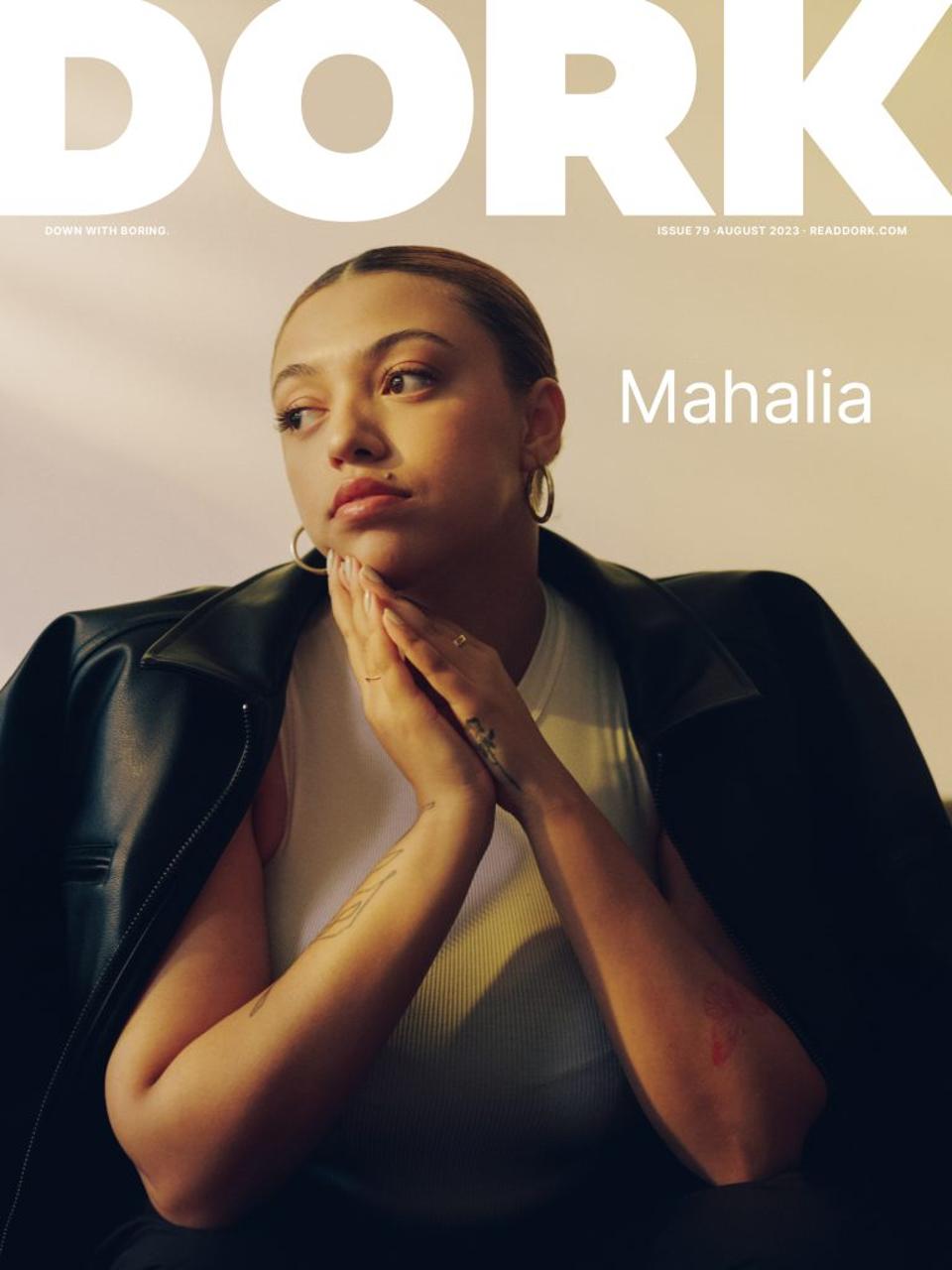
Embarking on an introspective journey, Mahalia's triumphant return with ‘IRL’ reveals her evolution as an artist, navigating challenges, embracing authenticity, and leaving an indelible mark on the British R&B scene.
REBORN
REBORN
Embarking on an introspective journey, Mahalia's triumphant return with ‘IRL’ reveals her evolution as an artist, navigating challenges, embracing authenticity, and leaving an indelible mark on the British R&B scene.
Embarking on an introspective journey, MAHALIA’s triumphant return with ‘IRL’ reveals her evolution as an artist, navigating challenges, embracing authenticity, and leaving an indelible mark on the British R&B scene.
Words: Martyn Young.
Words: Jennifer McCord.
When you’ve been away for a few years as an artist, you’re always looking for the perfect way to return. How can you reassert yourself and shake things up? As far as comebacks in 2023 go, there’s nothing more powerful than Mahalia’s ‘Terms & Conditions’. “I wanted to burst out of the gate,” she explains excitedly. “The first single is very hard to choose, but you can either ease in or burst out, and I just wanted to say: I’m here. I’m back. It’s coming.”
What’s coming is her stunning second album ‘IRL’, and it’s a record that establishes Mahalia firmly at the top table of British R&B. Full of confidence, ambition and a desire to create a true legacy for herself and her music, she’s making a statement on her own terms.
Everyone has known for a very long time that Mahalia was something special. Even going back to when she was first signed to Asylum/Atlantic Records as a precocious 13-year-old talent in Leicester, she was destined for greatness. Indeed, the accolades and the achievements of her first burst of fame and creativity culminating in 2019’s critically acclaimed debut ‘Love and Compromise’ make for impressive reading. There are the Grammy and BRIT Award nominations, the two MOBO wins for Best Female Act and Best R&B/Soul Act, as well as the huge festival shows and playing with the likes of actual Adele. Rarified company, indeed. It’s the reality of her journey so far and how Mahalia has the power to shape her destiny that characterises ‘IRL’ and shows us a new side to the supremely talented singer.
“Very simply, it’s been a fucking uphill climb,” she exhales as she tries to contextualise her rise. “At times, it’s felt like I’ve been running a marathon. I didn’t have the overnight success trajectory. That wasn’t really on the cards for me. Everything that I’ve done and every gig that I’ve done has gotten me to this point. Starting as a 13-year-old kid in Leicester, going to school and picking my GCSEs, to becoming a signed artist. From busking in the streets to playing open mics and playing shows.”
Hard work and passion were the things that drove Mahalia through her teenage years, and now, aged 25, she’s able to look back fondly on that period despite the struggles. “It’s funny when people talk about the grind because I feel like for a lot of people now it’s quick,” she says. “You might have a song that’s doing really well on TikTok or has a viral moment online, and everything goes crazy.
“For me, it’s always felt like a grind, and I’ve loved it. Based on the person that I am, a quick trajectory would have freaked me the fuck out. I definitely work better with slow and steady. It’s been a lot of work. I definitely felt like I was in the gutter for a lot of it. With that work comes incredible reward, though. Every time something happened, like last year when I won a MOBO, I cried from my seat to the podium, and I kept crying at the podium. Some people might not understand that response, but it’s because of the work and the time leading to that point.”
Mahalia’s music falls within the great tradition in British pop and R&B of using their own heritage and distinct voice to mesh with a broader aesthetic to create their own singular style. The importance of coming from Leicester and embracing the regional quirks has played a big part in her development from an early age. It’s a true melting pot of diverse influences.
“When I was a kid, I was surrounded by music all the time,” she explains. “My eldest brother was playing everything. He was playing all the hip-hop, my second brother was playing all the pop but the cooler pop. He was playing Britney and JoJo. Which is so funny because he’s now a rapper, and I don’t think he remembers the time when he was a pop kid,” she laughs. “My parents played a lot of reggae when I was a kid. Reggae is probably what. Reggae is what really made me find happiness in music. There’s nothing like it. Some of the music that used to fill the corridors, whether it be Bob Marley, most of the time it was Damien Marley, and really getting to experience music in such a way that it makes you feel happy about your day. Reggae really does something to me. It would signify my mum cooking in the Kitchen. It would signify my dad doing work in the garden. It had images for me. That was the beginning.”
"For me, it's always felt like a grind, and I've loved it"
— Mahalia
From that beginning, Mahalia began to take on her own musical passions. “A major turning point was when I picked up the guitar,” she smiles. “There was an artist I loved as a kid called Corrine Bailey Rae. She was also mixed, which I really related to, and she played the guitar and sang. I was like, oh, I want to be this girl. That was when I started playing. Around that time when I grew up in Leicester, the only things we were listening to were Arctic Monkeys, The Kooks and Jamie T. For a long time, I was inspired by those kinds of bands. I was inspired by how they would talk about stories, and I think that’s how I get my conversational style. Alex Turner would literally write a song and sing it like he would say it, and that’s what I try to do.”
In her Dork cover last year, amazing UK rapper Enny similarly enthused about her love of Alex Turner and his wordplay, and it’s clear that the Sheffield legend’s influence goes far beyond their typically indie lane. For Mahalia, it was the feeling of home and those very specific regional accent details that made them even more special.
“He used to say ‘owt’,” Mahalia grins. “I always say Leicester is not the north, but if you go to Leicester and listen to people talk, the accent has so many hints of northern in there. I think that’s why we love them because we do say ‘shut up’, and we do say, ‘come shop with me’. I was trying to say to my boyfriend, because he’s from London, when we were at school, and the teacher was getting us in trouble, we’d say, ‘Miss, we ain’t done owt’. He’d never heard that before. I think that’s why Alex inspired me. There were so many things in his lyrics and songs that related to us growing up in Leicester.”
As she developed and experimented with different sounds and styles, Mahalia’s voice became her calling card, and it’s that beautifully dextrous, nimble and super soulful voice that makes her debut album such a gorgeous listen. But, despite its success and undoubted lushness, there was something else that was needed to give her music a spark to take it to the next level. Struggle was once again to ultimately turn into salvation as she had to try to navigate getting through the pandemic while processing just what the hell she was going to do with her music next. The events of those years were unforeseen but crucial in shaping the tone and spirit of that all-important second album.
"I started therapy midway through the first year of the pandemic, and that is where I did all my growing"
— Mahalia
Like everyone, though, initially, the early pandemic phase wasn’t that bad. “I enjoyed the first month. I became a stoner for the first time in my life,” she laughs. “I was drinking a lot of wine and reading a lot of books. I enjoyed that time, but when it got to 4 or 5 months, I just lost my shit. I think it was the first time that I really had to stop and take a look at my mental health and think, is this depression, or is it not? Am I ADHD, or am I not? Honestly, it was therapy for me. I started therapy midway through the first year of the pandemic, and that is where I did all my growing. When I really got to get under the skin of Mahalia, the artist, and Mahalia at home. I also got to figure out that I really haven’t been that happy over the last few years.”
In the middle of this inward-looking pandemic-induced inertia, Mahalia began writing. “That was how I started writing my second album,” she continues. “I was becoming a different woman. I wasn’t on that trajectory any more. I was on a different one and had to figure out how to do that one. From album one to ‘IRL’, it felt like a huge development for me. It has reflection as well. I got to reflect on the girl I was then and the girl I am now. The title-track ‘IRL’ is basically about me as a kid and how much I wanted to be a singer. I got to spend all that time and therapy and really get to grips with who I was. That’s why some of the album feels quite reflective because that’s what I was doing at that time.”
The reflective quality gives the album a real calming lucidity and clarity. Mahalia is at ease with who she is and recognises the struggles she’s had to get there. “There’s a word that labels tend to use, and that’s aspirational,” she states. “I’ve always hated that word. Labels tend to use it in relation to artists where they say you need to be aspirational. People need to aspire to be like you. No, not aspire to be like you. Aspire to BE you. My thing was always that I was too relatable. I thought that you could be aspirational by being relatable. I think people can fall in love with you and want to be like you because of your relatability and your honesty.
“In the beginning, I wanted to act like a friend to fans; I can’t text my fans and speak to them on the phone because that would be thousands of people, but I wanted them to feel like my songs were also written for them. That was my goal when I was a kid, and that’s always been my goal. With this album, I want people to come away from it and say Mahalia showed me something or taught me something. The goal has been to be a kind of big sister, friend, and mentor, and I think you can be aspirational and be that person. The album finishes on ‘IRL’, and the last part of ‘IRL’ starts by saying, ‘So my last piece of advice’. That really is who I am. I don’t want to tell everybody this is what you should do, but I’d like to offer some of my 25-year-old wisdom.”
Through making the album, Mahalia worked predominantly with the same team she collaborated on with the first album with JD Reid, Max Pope and her partner Benjamin Hart who played an ever bigger role on this album. “I wrote most of the album with my partner. I think that in itself was a learning curve for both of us. We were having to write songs sometimes about each other in the same room.” Perhaps this gives the album some of its intimacy and closeness. “I was really surprised at how hard I found it in the beginning,” she admits, though. “I was surprised that after a two-year break, I couldn’t just get started immediately. I had to ease myself back in.
“That was the first thing that freaked me out. One thing that I’m very happy I did on this record is I worked with a lot of the same people over and over again; I think that allowed me to find my voice as an artist. A lot of making music nowadays, half of the session is meeting people and trying to say hello and get a vibe from each other, and then you’ve got to write a song. I find that process excruciating. It was nice to work with the same people and not have to do the getting to know each other, and come into the room and immediately start creating. The start of the process was horrendous for me in my head as I just didn’t know what to do, but finishing the album and then looking back on it, I had so much fun making it.”
One of the most striking aspects of the record is the featured artists that drop in and complement Mahalia’s central character. “All of these features came around super organically. Everyone on the record I’m a really big fan of already, which always helps. I definitely took the lead with it,” she explains. “The first feature I got was JoJo,” who’s on the whip-smart anthem ‘Cheat’. “That was crazy for me and felt like a real full-circle moment. I loved her so much as a kid, and being able to do that was amazing.
After lifting some new talent, the final two features are modern legends of the game. “The final two, I went with Kojey Radical, who’s like my big brother; I wanted to have another moment with him. Stormzy was huge, though. I think everyone was expecting me to make a rap record with Stormzy, but I decided to get him to sing. I’m hoping that it’s going to be a few first dance songs.”
Indeed, the desolate plaintive quality of Stormzy’s voice on the gorgeous ‘November’ is a jaw-dropping album highlight.
Bands Reunited: Who's Getting Back Together and Where Have They Been
If the last few years have proved anything, it is that reunions are bigger than ever.