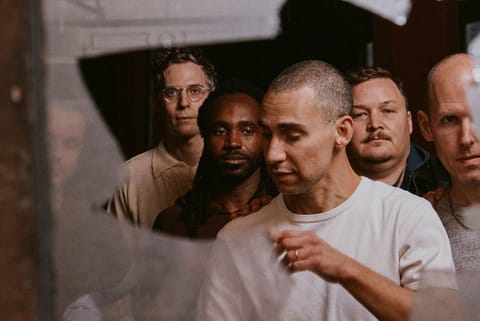
Dealing with beginnings and ends, ‘All These Countless Nights’ seeks out a sort of closure and Deaf Havana live it. Announced during their set at Reading last year - not just because it was one of the few gigs the band would play that summer, and it was in front of the biggest audience - but because “it was sorta the anniversary of when we almost broke up.” Deaf Havana find poetry in the everyday. “We wanted to announce it, but we didn’t want to be boring and do what we normally do and post on Facebook or whatever,” explains James. Taking inspiration from the front cover of comeback stormer ‘Sing’, the band joked about playing in front of a blank canvas before someone came and graffitied the title onto the backdrop. Jokes quickly turned into plans and “it actually worked out way better than we thought it would. It’s weird for us when stuff like that goes well because normally it goes wrong.” Luckily there were no missing ‘o’s. “That was my biggest fear. Can this person actually spell? Because that would have been horrendous.” “We were playing around with a bunch of titles for a while and ‘All These Countless Nights’ [taken from ‘Happiness’] is one of the ones that probably had the least thought put into it. In the vaguest, lamest way ‘All These Countless Nights’ sums up every single song on this record. As vague and basic as it sounds, they were all written about countless nights I can barely remember. Inspiring both hope for the future and a resignation of the inevitable, the title and the record tells both sides of the story in lush, horrid and rainbow-drenched detail. From the self-disgust of ‘L.O.V.E’ and the destructive misery of ‘Happiness’ that both deal in the opposite of what they promise, to the endurance of ‘Like A Ghost’ and the fight back of ‘Sing’, all swagger and curled lips, Deaf Havana don’t hold anything back. Nervous before showing anything off and still a bit anxious before giving it over to the world outside, James doesn’t let that stop his pride. “I think it’s the best thing we’ve ever done.” After debating his nerves for a few moments, he comes back with: “No, I’m quietly confident, to be honest.” More diverse and taking in more stops than anything the band have previously put their name to, their fourth album sees Deaf Havana stretch like never before. Everyone likes to mix their drinks, but it’s not a deliberate move. The band have never been ones to try and please other people. Instead, they write what they write and let it happen. It’s how ‘Old Souls’ and ‘Fools and Worthless Liars’ came to be, and ‘All These Countless Nights’ is no different. They’ve never followed trends. “We probably should have done,” laughs James. “We are outsiders in a way, but we have been from the start.” The breadth is “purely because it was written so naturally over a period of three years. I was in a different head space and a different geographical location. All the songs have different influences. That’s where the diversity comes from, and it’s a much better record for it. “The danger in that is that none of the songs will fit together and it won’t sound like an album but somehow, it does flow. I’m really happy about that. It could have gone differently.” That’s the Deaf Havana story, really. And while the spirit of doing their own thing and not paying attention to trends is the same as always, getting to ‘All These Countless Nights’ was completely different. “Normally the studio time is booked before I’ve even written a record, or it has been for the past two albums, so I have to rush and write songs in a month-long period. For ‘Old Souls’ we had exactly twelve songs, which isn’t particularly good. This time, because it was such a long time and such a natural writing process and I didn’t even know if we were going to use them, I ended up with this whole bank of songs, which is a nice problem to have. You can just pick the best ones. We spent a lot of time working out which ones fit together.” Flirting with politics and religion against a backdrop of James’ life, ‘All These Countless Nights’ is a more aware, eyes-open record. “I was going to say I ran out of things to write about, but I guess I’ve just grown up a lot. I think differently now; I’m not as obsessed with depressing stuff. I realised there are bigger things. The songs on this record just came out naturally, I didn’t sit down and think, right, I’m going to write a song about blah blah blah. It was an organic process. Obviously, the songs are quite different because I wrote them in different states and different periods, but the overriding theme is trying to be a better person and acknowledging the things I’ve done wrong and the mistakes I’ve made in the past. When I listen to a record, I want to hear the highest highs and the lowest points of someone’s life. I like to hear that vulnerability, and I want people to be able to relate to it as much as they can. I hope this record does that job. It should have been released two years ago, but it’s definitely the one. It’s the one,” James repeats before pausing. “If we hadn’t taken that time away, I don’t think it would have sounded like this. It probably would have been another rush to get ready and not end up sounding so diverse. I’m actually glad everything panned out the way it did.”