
As Gainesville’s Fest buzzes around him, the Get Up Kids’ singer reflects on addiction, acceptance and making art for the right reasons again.

As Gainesville’s Fest buzzes around him, the Get Up Kids’ singer reflects on addiction, acceptance and making art for the right reasons again.
Fourth Avenue Food Park might just be the hippest – and most serene – place in Gainesville to grab a spot of breakfast before the carnage of Fest takes over. Over the course of three mornings, we'll spy reformed indie titans Good Luck and up-and-coming power-pop champs Camp Trash, while emo heroes Kerosene Heights – riding high on the back of their excellent sophomore effort 'Blame it on the Weather' – will make it their regular morning haunt.
There's the big names of Fest, too – Max Stern (Signals Midwest), Evan Weiss (Into It Over It/Pet Symmetry), and Erik Hunter Czaja (Dowsing/Pet Symmetry) – they'll swing by for their daily dose of bagels and coffee. In short, if you want to do a spot of DIY emo star spotting, this is the place.
It's super chill, too. To the point that when the instantly recognisable Get Up Kid Matt Pryor rocks up, nobody bats an eyelid. Perhaps more than most festivals, the Fest has cultivated a lack of barriers and a healthy respect for personal space, and this is reflected around town pre- and post-event, too.

"I like this festival," comments Pryor as we sit down to talk about his superb and searingly honest new solo record, 'The Salton Sea'. "It's a punk festival… It's a good punk festival. I usually don't like festivals – there are all these people milling about backstage trying to be seen. It just turns me off – always has done. Here, I don't even know if they have a backstage. I think there's just a toilet."


Before we get to 'The Salton Sea', it may be prudent to add some context. The album will drop almost immediately after the Get Up Kids end their mammoth run of nostalgia shows, which started with anniversary gigs for 1997's much-loved debut, 'Four Minute Mile', and ended with a near two-year celebration of 1999's epic and iconic 'Something to Write Home About'. Both albums left an enormous imprint on the musical and cultural landscape at the time – indeed, you can probably trace the legacy of those two records in the sound of 80% of the bands playing at Fest this year.

Yet they have also presented a challenge for the band members, and Pryor in particular, as they navigate this sense of prolonged adolescence with the feelings of being valid and credible artists with something relevant to say in 2025. Ultimately, how does an artist feel creative while celebrating the past? It's a position Pryor found himself dealing with while working on 'The Salton Sea'.
"That's something I've been wrestling with. With the 'Four Minute Mile' tour, I felt like the nostalgia was the only thing anyone really cared about; I lost any inspiration to do something for myself; it was all about doing the tour for money, and I was in a really negative headspace.
"It's like that quote from George Clooney, where he was talking about making an Oceans movie and then an indie movie. It's like, 'This pays for this,' and one has a bigger audience and makes lots of people happy.
"The 'Something to Write Home About' tour, I get why people care about it. Artistically, it might not do much for me now, but I get it, and I understand it. But it's also the reason I can take four months off to fulfil all the Kickstarter orders for the new record. I can appreciate that concept a whole lot more because of it."
While Pryor is candid about his motivations, he's also aware of what art means to him. 'The Salton Sea' has something to say, and he's justifiably proud of the end results. Writing as a longtime fan of the Get Up Kids, New Amsterdams, Radar State, and his solo work, it's his finest album in well over a decade – and at its heart is a story of addiction, realisation, and recovery. It's in marked contrast to his last solo effort, 2017's 'Memento Mori'.
"I don't think that record's terrible, but it's definitely not coming from a good headspace," comments Pryor, whilst also acknowledging the far more successful Radar State and more recent Get Up Kids records (2018's 'Kicker' and 2019's 'Problems'). "It ['Memento Mori'] was coming from a place of needing to go on tour to make a living, so I needed to put a record out. I think it was reverse-engineered from there, and that's not a good place to make art from."
Instead, the motivation for 'The Salton Sea' came from positive changes Pryor made in his life – namely, getting sober. While in recovery, he started journaling, writing down stories and anecdotes of what he'd gone through on his journey. He was prolific, too, writing 1,000 words a day from last October – which, off the back of his 'Red Letter Days' memoir, was no mean feat.
These essays formed the basis of the 10 songs found on 'The Salton Sea'. The album starts with the good times but quickly unravels by the time it hits the fourth track, 'Union Transfer'. The song is about the final show on the 'Four Minute Mile' tour, where Pryor describes going through an "existential crisis" of not knowing who he was.
"I really remember that night just feeling like 'Why am I here?' And I understand now that that's a normal thing people feel, but to have it at a show where you're the singer of the band, and everyone's really excited for you to be there… but depression doesn't follow any logic.
"It's really hard to explain without sounding ungrateful, but you lead a charmed life being in a band, and I was in a really dark place, and I couldn't appreciate the positive thing that was happening around me.
"It's a lot like, 'This should make me happy. Why isn't this making me happy?' And then you get mad at yourself for not being happy. And then you feel shittier while the people around you are saying 'This is great!'"
In many ways, Pryor's experience echoes those of Militarie Gun's Ian Shelton. The Californian punk's latest opus is an equally powerful journey of self-discovery – even though Shelton is about two decades Pryor's junior.
"First it was Turnstile Summer, and now we're in Militarie Gun Fall," quips Pryor the first time Shelton's name is mentioned, showing he still has his pulse on what's happening in the punk rock world.
"It's interesting he came to that conclusion now, because I had that same moment in 1999 and didn't know what it was or how to deal with it," says Pryor as we discuss the similarities between such candid records. "I didn't start drinking every day until then, and I guess it took him [Shelton] three years to figure that out when it's taken me 25," he deadpans.


Pryor's in a much more positive headspace these days. His Substack is a fine example of how writing and journalling have both helped his creative process and served as a document for his journey, chronicling the ups and downs while providing a candid – and occasionally uncomfortable – insight into his psyche.
In one of his most recent posts, he talked about buying a new pair of Converse Jack Purcells for the first time in years. This led to a rumination on rediscovering his sense of self and learning more about who he is as a person. It's a beautiful, funny, and poignant story.
"Here's the thing," starts Pryor. "I assume this is the same for everyone going through recovery, but you suddenly have a series of firsts. 'This is the first time I've gone to a show not drinking. This is the first time I've gone on tour not drinking. This is the first time I've had sex not drinking.'
"I remember the time before I started drinking; I didn't start drinking when I was 14 or something, like a lot of people in recovery do. I started drinking – and drinking heavily – when the band was already successful, because I was bored and unhappy. So, I see so much of myself from before that, and from the first two years of the band, coming up for air.
"I like Jack Purcells because they're like Chuck Taylors but a little bit different. They're not like what everybody else wears – and I like that, that's cool. And that's my personality. That's the sort of thing you do when you know yourself.
"It's like 'Maybe I should wear a suit jacket on stage', and you try it, but it's like 'Well, that doesn't feel like me'. It all comes back to acceptance. It's boring how often I talk about acceptance. It's really 'This is what I like, this is who I am, and this is who I honestly was before I got into this mess'.
This sense of not knowing yourself is reflected in the track 'The Dishonesty' – probably one of the two most lyrically pointed tracks on the record. From an outside perspective, it's perhaps too harsh on its protagonist – it's certainly the most uncomfortable moment on the record (even if it is a banger), reflecting Pryor's mindset in going out to write his memoir at a brewery.

The other, 'Maria', is a composite character created from the myriad nurses and professionals who looked after him while he was in the hospital, where he received mixed messages about what to do.
"It's almost like they don't want to tell you what to do with your life. They're kind of like, 'Maybe you should cut back on drinking,' or 'You need to stop drinking. Have you ever had to put a pet down? The vet doesn't want to say, 'It's time,' because you might be like, 'Fuck you, it's not time.' That's what it made me think of. I was the pet in that scenario."
Which is a somewhat interesting domestic analogy, given 'The Salton Sea' is something of a family affair. Pryor's youngest child, Jerzy, plays bass on the record, while his touring party for the record – in the US at least – involves Jerzy and his oldest child, Lily (who will be opening the show with their folk-punk outfit 'Small Uncle'). "We're working up this folk trio thing, where it's really more about the singing and the harmonising together, because I think it sounds really good," says Pryor.
When I ask if he's concerned about spending several weeks in the van with his children, he laughs: "It's not like I'm dealing with difficult people; I mean, as much as kids are difficult. We get along fine. I give them their space, they give me mine, and we have conversations about politics in the van."
In fact, it sounds like a blast, and while heavy themes abound on 'The Salton Sea', it's also packed with songs that will rip live. 'Barrymores', 'The Dishonesty' and 'Darken My Door' are all classic additions to the Pryor canon. 'Doubt', meanwhile, is a rousingly triumphant closer while 'I Don't Pray' is an acoustic strum that would have shone on a New Amsterdams record. It means 'The Salton Sea' is the perfect marriage between message and delivery.
"I want people to be able to listen to the record and be like, 'I like that song', considers Pryor. "I'm always happy to be an advocate for what's worked for me, and I don't want to come across as preachy or like I'm selling supplements. I guess I'm in the wellness space now, as they call it.
"But this is what I went through, and this is the story. You can take it or leave it. I think the songs are catchy enough that you can just listen to them anyway," he jokes.
'Story Like a Scar' may be the title of a 2006 New Amsterdams record, but it feels like an appropriate point to end on. Pryor's come through a rough patch with some stories and a few scars. 'The Salton Sea' serves as a powerful testament to this journey and resilience, set to some of Pryor's finest compositions in years. It's more than a winning return, it's positively redemptive.
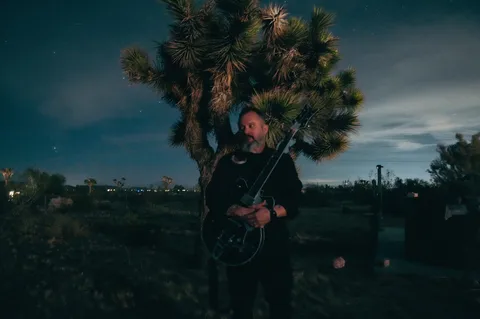
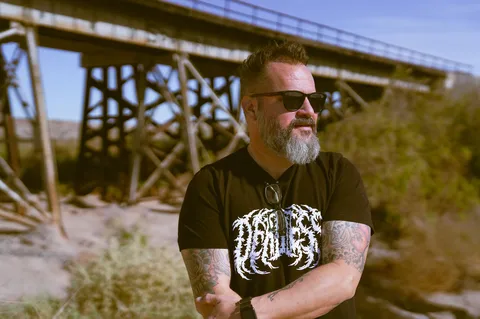
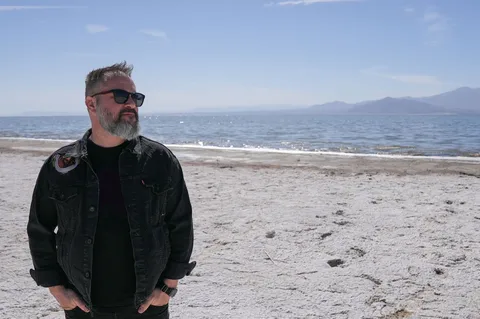
Matt Pryor's new solo album 'The Salton Sea' is out 14th November.