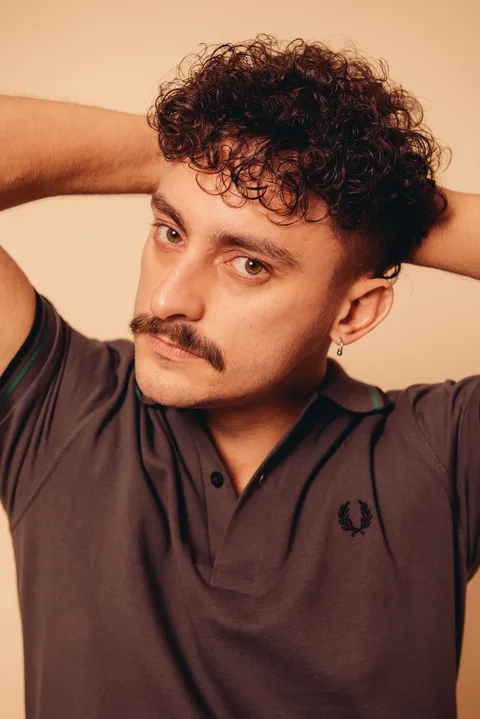
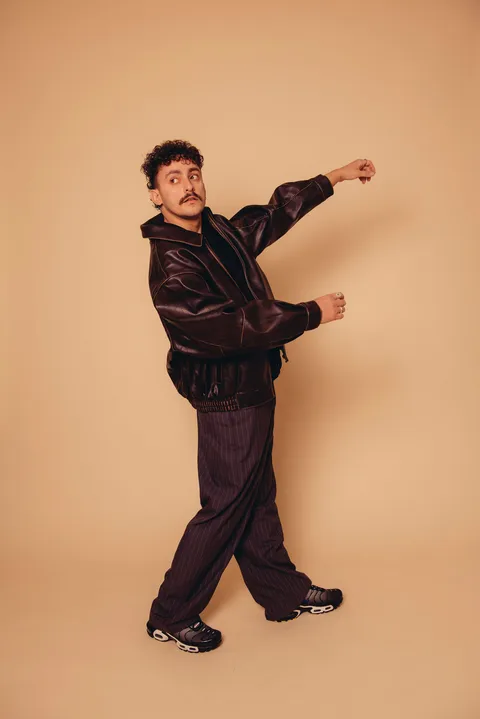
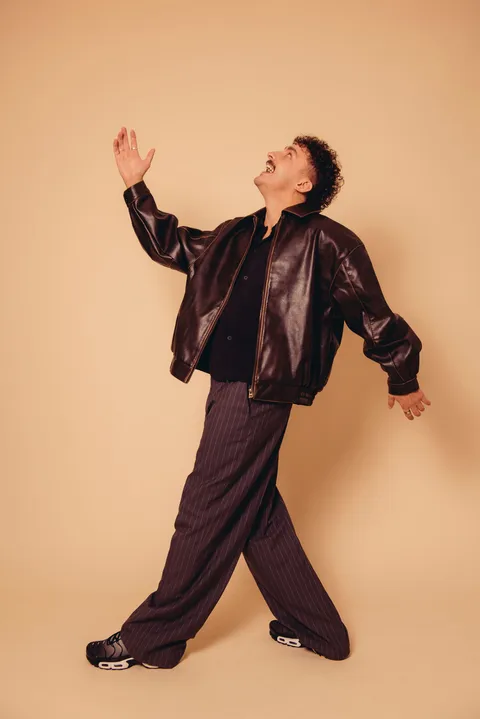
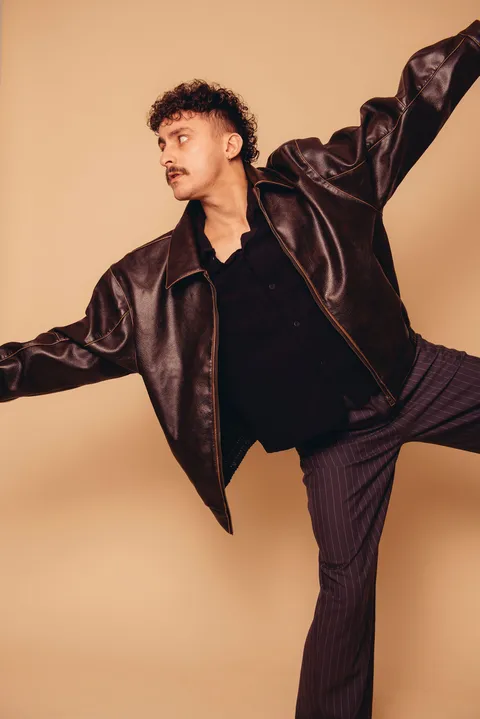
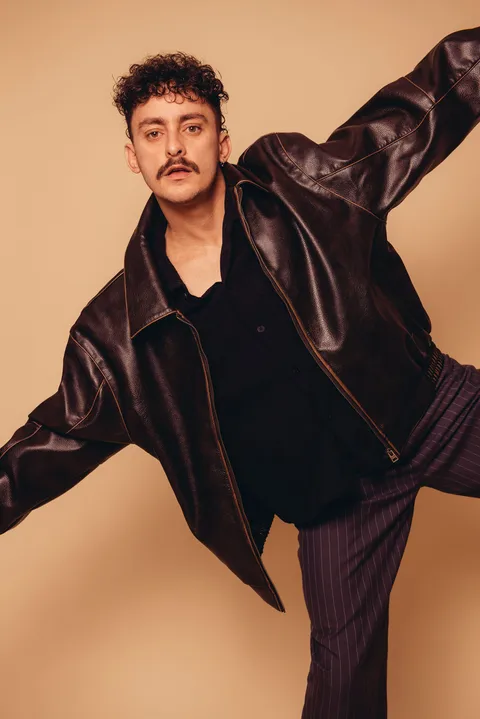
The Hitchhiker's Guide to Manchester's dance floor philosopher, Antony Szmierek | Dork
From classroom teacher to indie-dance pioneer, Antony Szmierek’s debut album transforms mundane service stations into portals of profound meaning and connection.
GROWTH
GROWTH
From classroom teacher to indie-dance pioneer, Antony Szmierek’s debut album transforms mundane service stations into portals of profound meaning and connection.
Manchester’s musical resurgence is well and truly underway, assuming it ever faded away at all. Between Blossoms’ gorilla-centric new album and the understated (or not) return of Oasis, the North West is deservedly back under the microscope. In amongst all the Britpop buzz lies an artist quietly building up an indie-dance portfolio that will see him battle in the big leagues. Whether it’s in the form of a big glass pyramid in Greater Manchester or an intergalactic motorway service station, Antony Szmierek is here to inject some much-needed heart and soul into these increasingly grey, unpleasant lands.
Since the release of 'Poems To Dance To' in 2023, Antony’s played approximately six million shows, had singles spun on BBC radio, and appeared on Later… with Jools Holland. Oh, and he ended 2024 on tour with trip-hop legends Faithless, just to top it all off.
Now, he’s starting 2025 as he means to go on, releasing his debut album 'Service Station At The End Of The Universe' before heading back out on his hectic hamster wheel of sold-out solo shows and festivals all over the shop.
Before transitioning into a full-time musician, Antony spent his days as a teacher, grounding him and his work in the realities of life in the oft-neglected suburbs of England’s bigger cities. Creating a humble nature that permeates through all of Antony’s work, he keeps an inherently working-class suspicion of creative industries to ensure that he doesn’t lose sight of the whole purpose of the mission: to keep making a difference through his music.
The track that most clearly resembles that sense of impact is “The Words To Auld Lang Syne,” a deeply emotional track that quickly worked its way into the hearts and tear ducts of Antony’s fans globally.
He continues: “We played New Century Hall in Manchester, and people were hugging their partners and crying,” he wistfully recalls, “but we even played [Electric Castle] in Romania and there was a woman who clearly related to [‘The Words To Auld Lang Syne’] and let go of anything she was feeling. It’s mad that it can connect like that in a place that doesn’t even share the same language.”
"The album is almost like ‘Antony Szmierek: The Movie’, where everything is glossier, bigger, and better"
Antony admits that their performance at Electric Castle was one of the highlights of the last year, embodying the energy that seems to be surrounding him and his bandmates at the moment, most easily summed up as the culmination of years of starry-eyed ambition and steely-eyed determination finally resulting in some success.
The live show is where Antony Szmierek, both as a person and as a musical entity, really sparks into life, blending together rave-inspired hooks with a determination to deal with the big questions. Both of these ideas are placed at the centre of his upcoming debut album, 'Service Station At The End Of The Universe', due out in February 2025.
'Service Station At The End Of The Universe' transforms a motorway services on Antony’s fantasy motorway, Andromeda Southbound, from a place where dreams go to die into a study of social complexity, following the lives of the different characters that pass through on their way to a yoga class, a wedding, or back home to the one they love.
Introducing characters that in part represent Antony’s beloved North West upbringing, such as “the Patron Saint of Withington” in 'Rafters', but also illuminate parts of Antony’s own personality and questions that he himself deals with on a daily basis. Whether it’s accusations of being a class traitor in 'Yoga Teacher' or trying to cope with overthinking and existentialism in 'The Great Pyramid of Stockport', Antony’s whole self is poured into every aspect of the record, making it as genuine and believable as it could be.
Drawing on his eternal love for ‘The Hitchhiker’s Guide To The Galaxy’, one that ignited Antony’s passion for language, as well as local landmarks that have become key pillars of his life thus far, every picture is painted with nuance, style, and an observational accuracy that even the most experienced novelists struggle to recreate.
Pulling different literary ideas to the edges of their existence and rewinding threads to fit his huge new universe allowed Antony to create more lyrical layers than is possible on singles and EPs and underscores his immense writing talent.
This ethos is at the heart of almost every track on the record, taking a seemingly everyday object or idea and elevating it into something with a profound and often existential meaning. The most obvious example of that comes from single ‘The Great Pyramid of Stockport’, which sees Antony take a local landmark and draw threads to the Pyramids of Giza, using two structures built centuries apart to explore legacy in a world that values speed and innovation.
“I was really surprised that nobody had written a song about it before; I was certain that Blossoms were gonna mention it on their album! On the surface, it just sounds like a song about this insurance company’s office in Stockport, but there’s a lot on there about getting older and time never stopping. There’s also a line about me cancelling plans because nothing feels real and I’m in tears in my bedroom, which sounds mad to have in a song about a big blue pyramid. I basically use observations as a way of projecting quite a complex idea, so the Stockport Pyramid actually ends up representing the question: ‘What’s the point in any of this?’”
“I just don’t want to be hemmed in; I want to be able to do a metal song on the next album if I want to!”
Taking his cues from goth giants The Cure, Antony tried to be as sneaky as possible with his introspection, peppering super vulnerable lines into songs that you can only pick up on after a few listens. In this way, the album is able to bring together complex trauma responses and deep-rooted existential anxiety without ever getting weighed down by heavy topics.
This hitman-like style of hiding his vulnerabilities comes to a head in ‘Restless Leg Syndrome’, a stream of consciousness that acts as the end of the album’s spiral, representing rock bottom before the album bounces back to peace, love, and joy. It’s fair to say that it’s the song on the album that is likely to become a fan favourite thanks to its brave open-heartedness, but also the one that Antony struggles with the most.
He continues: “I still wanted the record to be optimism bottled, though, and that’s why it ends on ‘Angie’s Wedding’. I guess it’s an allegory for heaven, it’s not elitist, everyone can go, it’s a celebration. I just needed to resolve it and say, ‘It’s all going to be ok in the end’, instead of ending on ‘Restless Leg Syndrome’ or ‘Crashing Up’, which is about getting older and having eczema; what a nightmare life is!”
Sonically, the record is as rooted in Antony’s personal and local past as the lyrical subject matter, clearly marked by Forton Service Station’s Pennine Tower adorning the album cover. Initially, though, re-establishing these close ties to the historically well-documented Manchester music scene was something that Antony pushed back against.
The record combines the dance-pop, Haçienda-inspired beats that were present on ‘Poems To Dance To’, but turned up a notch to create a bigger, juicier sound. Alongside that, there are guitar-rock riffs, late-70s synth-pop, and a healthy whack of ambient house and jaunty, warped beats that illuminate links to classic Manchester bands.
“In the end, I realised there was a way to lean into the bands and the history that nobody up here shuts the fuck up about but still keep it different,” he chuckles defeatedly. “It was the first and last tracks that really cemented the sound. ‘Service Station At The End Of The Universe’ sounded like a Primal Scream track, and ‘Angie’s Wedding’ had that 90s wonky piano; when we first played that track to management, they were like, ‘Can we get more of that beat at the end?’ and we had to say, ‘No, because it’s not a Happy Mondays record!’ I could lean into that Manchester sound but still include nods to LCD Soundsystem and Orbital; the whole album distils down to dance music played by an indie band with loads of words.”
He continues: “I wanted it to feel like a step up from anything I’ve done before, almost like ‘Antony Szmierek: The Movie’, where everything is glossier, bigger, and better. I did a lot more thinking about the music this time so that I could keep it all cohesive. It’s like if someone was driving down the motorway in 1996 with a mixtape on, so it’s eclectic, and there’s that rave influence, but also songs like ‘Crumb’ where it’s like ‘ok, what if Backstreet Boys did poetry?’”
It’s an album that plays at the fringes of indie-rock, EDM, and alt-pop, all coming together to create a sound that bends and moulds itself to each unique idea, whilst still ultimately returning to the same hopeful core that Antony puts into all of his music.
It’s this hopefulness that allows the album to stretch at the seams without feeling muddled or over-exaggerated, journeying from the hedonistic euphoria of homage to raves in ‘Rafters’, through to a full-throated declaration of love in ‘Crumb’, via a confusing visit to a ‘Yoga Teacher’. Intelligent lyricism is interspersed with quick wit and open-hearted anxiety to create a tapestry that is as rich as it is diverse and distinct.
“I just don’t want to be hemmed in, I want to be able to do a metal song on the next album if I want to!” he giggles. “I don’t want to release some