
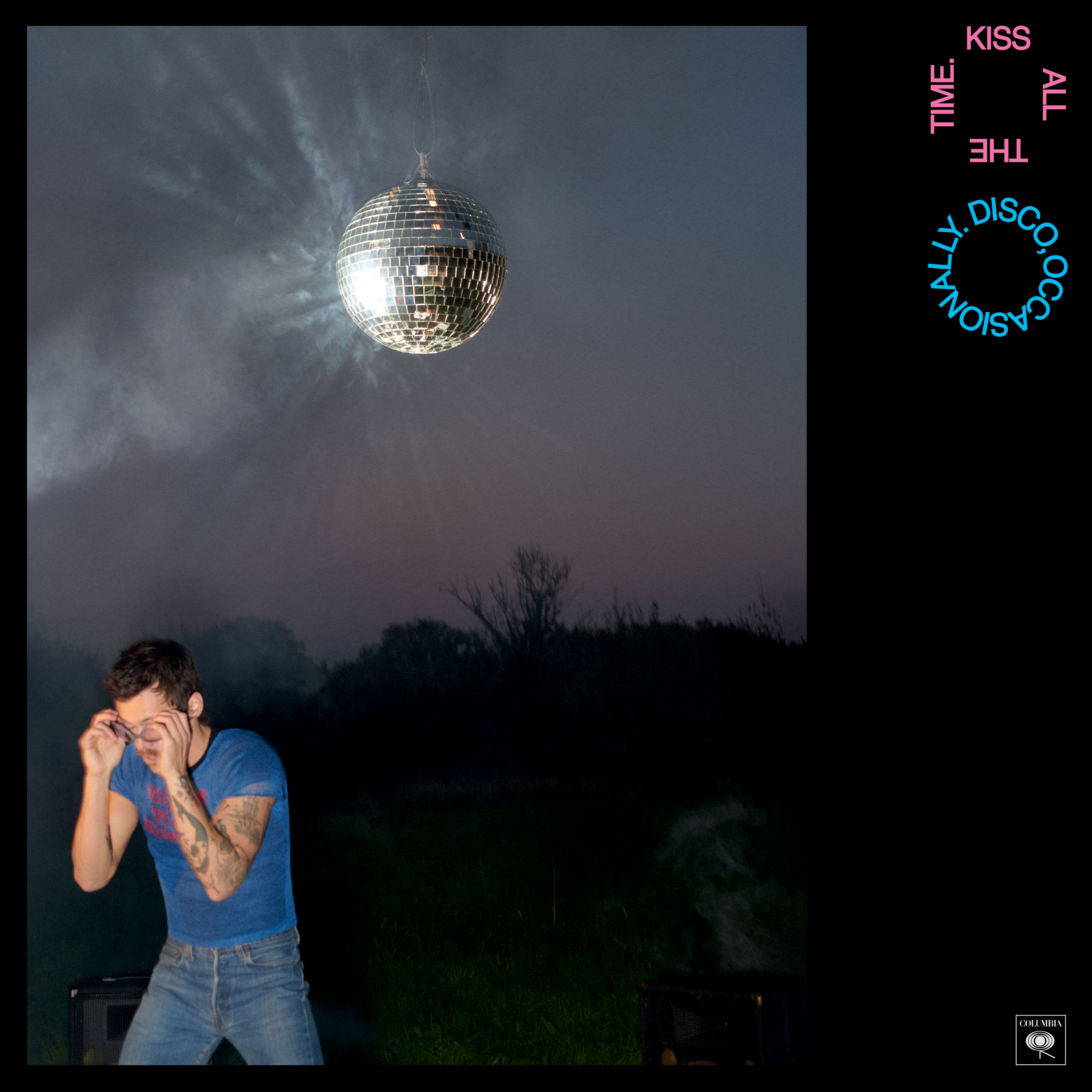
Harry Styles - Kiss All The Time. Disco, Occasionally
This isn’t an album built like a straight line from hook to hook. It moves in waves, often favouring texture and atmosphere over immediate release.
Calling an album 'Kiss All The Time. Disco, Occasionally' and then leading with a five-minute single that resists obvious fireworks is the kind of ballsy move you get to make when you're the world's biggest male pop star. Whether you hear that as a tease or a pop-science thesis, it sets the tone quickly. This isn’t an album built like a straight line from hook to hook. It moves in waves, often favouring texture and atmosphere over immediate release.
That doesn’t make it a retreat. If anything, it sounds like a deliberate side-step from the cleanest routes available to Harry Styles. The polish remains, as does the melodic instinct, but the centre of the record sits elsewhere. It has a heavier electronic framing, more low-end pressure and fewer instant sugar highs. Even when the choruses arrive, they tend to come in sideways, wiggling their hands like antennas to the sky.
‘Aperture’ works as an opener because it establishes those terms clearly. The synths blur rather than burst, Styles’ vocal often sitting back in the mix instead of pushing through. The effect is less “big statement single”, more “room-setting.” Across the record, that approach repeats: dancefloor elements are present, but always in service of the vibe.
That’s the key tension running through the album and, arguably, the title itself. There is disco here, certainly - you can hear it in the rhythmic architecture and the recurring urge towards communal lift - but a lot of this music sounds closer to the hours around the party than the centre of it. It is often nocturnal, slightly foggy, and deliberately in-between.
Where 'Kiss All The Time. Disco, Occasionally' is strongest is when that transcendental feeling is paired with songs that commit to a shape. ‘Ready, Steady, Go!’ provides one of the album’s clearest kinetic lifts, while ‘Dance No More’ is the most straightforwardly satisfying collision of groove, wit and momentum. It’s one of the moments where the record’s dance language feels fully embodied rather than referenced.
‘American Girls’ is likely to divide the crowd. For some, it will read as immediate and catchy (yay!), for others comparatively slight (boo!). What it does do is a damn good job at mapping the album’s middle territory. ‘Season 2 Weight Loss’ pushes into rougher textures, less interested in comfort than in friction. Even if it won’t be everyone’s favourite, it adds range.
The high point is quite probably ‘Coming Up Roses’, which brings together arrangement, vocal control and emotional clarity in a way few tracks manage as completely. It’s expansive without being overblown, and one of the clearest demonstrations of how effective Styles can be when he keeps the performance focused and unforced. ‘Paint By Numbers’ also lands strongly, particularly in how it frames image, identity and performance pressure without over-explaining itself.
That last point matters because one of the album’s genuine risks is its relationship to abstraction. Styles has long favoured fragments and implication over blunt declaration, and here that instinct is pushed to extremes. At its best, it creates space and replay value; at its weaker moments, songs can feel under-defined - especially for quite probably one of the biggest commercial releases of 2026. Your tolerance for that will shape your overall verdict, but to be clear, it's good. Better than good. It's interesting.
What can be said with confidence is that this is not a conveyor belt of radio-sized certainties. Its pacing, production, and sequencing all suggest a preference for mood coherence over sheer hit count. When pop is so often split between maximal event records and hyper-optimised playlist engineering, that reads as a meaningful choice in and of itself.
Get more Dork

Sessions · Playlists · Behind the scenes