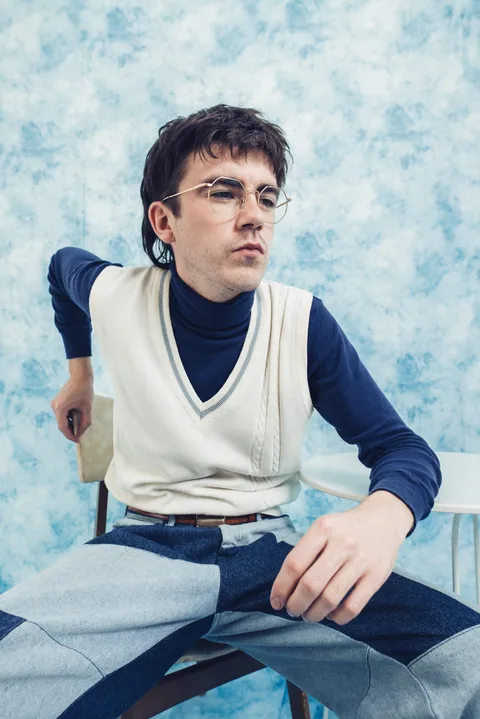
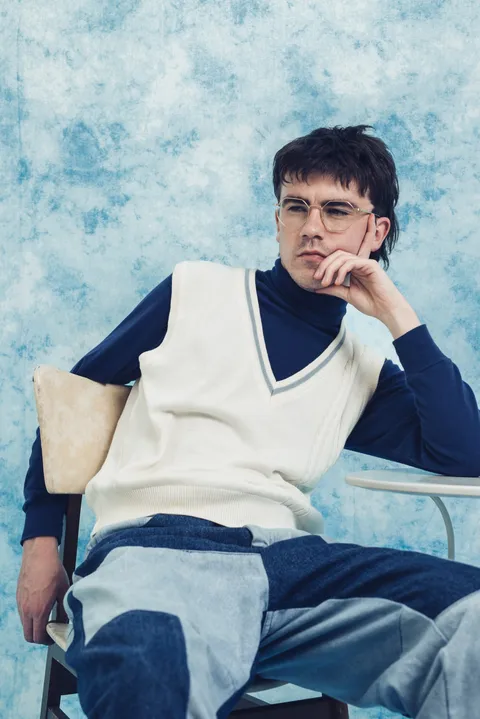
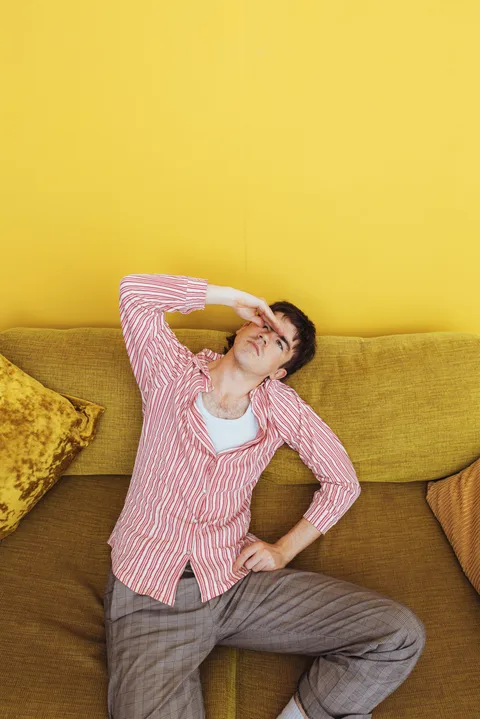
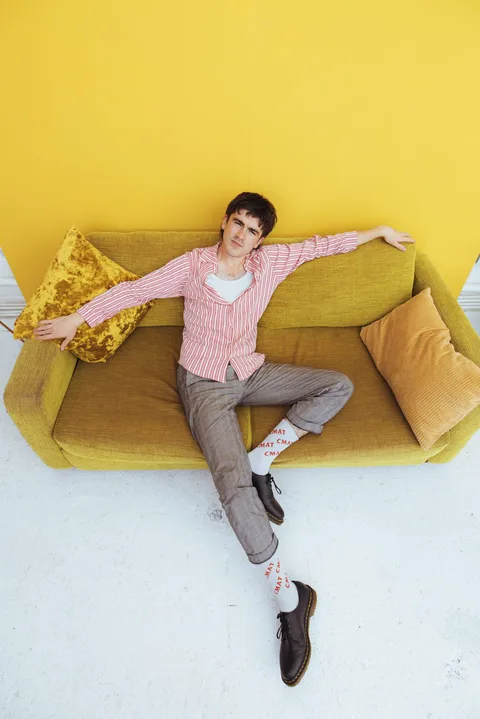
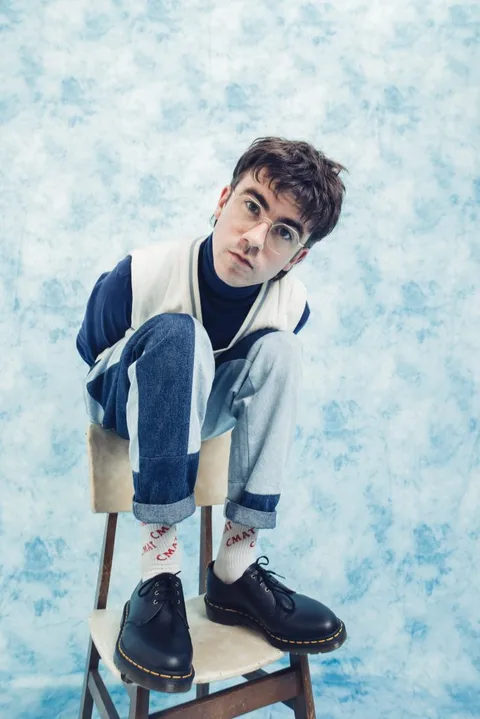
DECLAN MCKENNA is undoubtedly Dork’s prince of indie. Now he’s back, with a new album on the way, and a brand new vibe.
Words: Martyn Young.
Photos: Derek Bremner.
"I live by the sea, so I spend most of my time by the sea.” Declan McKenna is sitting in his bedroom at home in Brighton, eating a pain au chocolat, and is very much at peace with the world. “We’ve been paddle boarding recently,” he continues. “When the weather is good, I’ve been paddle boarding.
“The first person to take me paddle boarding, funnily enough, was Eli Smart when I went to meet him for the first time in Hawaii as I’d been working on music in LA. We went paddle boarding on this lake, and he said he hadn’t even seen it there before, but it was probably midnight or very late as it was dark, and there was all this bioluminescent algae.
Now, you might wonder what all this fish talk has to do with Declan and his new album? Well, nothing, but maybe equally everything? “I just like being in the water at the minute. I find it the most calming thing, whether it’s on a boat or swimming. It makes sense for the album that I’ve been making.”
The album he’s talking about is ‘What Happened To The Beach?’ and the bioluminescent trippy fish he’s talking about provide an apt illustration of the bonkers, vivid, odd pop brilliance of his best album yet. A collection that is idiosyncratic, playful, ambitious and resolutely Declan in a way that defines one of our most creative talents.
We’ve followed Declan right from the start at Dork. All the way back to when we spoke to him for the first time in Issue 1, in 2016, pre-debut album, when he was first finding his musical feet and proclaiming that “I’m always changing things about how I’m making music.” We were there with his first Dork cover feature in 2017 as he burst out with his dynamic debut album ‘What Do You Think About The Car?’ and we chronicled the birth of his dizzyingly ambitious opus ‘Zeros’ with a second cover feature as he tried to navigate the uncertainty of peak pandemic.
This time, though, things feel more relaxed in the world of Declan McKenna. The ambition and drive are still there but filtered through the prism of all the knowledge and experience he has gained from almost a decade of creation and evolution. Making up for touring lost time during the wilderness years of Covid that coincided with ‘Zeros’’ roll-out, the last year has been jam-packed for Declan.
The album he has made definitely occupies its own space in his discography. It’s ambitious in a very different way from his previous album, centred on a more reflective vibe. “It’s a little bit more specific sounding than the other stuff I’ve worked on. It’s a much more sensitive record. It’s quite exposing and sonically quite vulnerable,” he explains.
“I had more places to hide working the way I did on the first and second albums because the sounds were so full. That hasn’t been what I wanted on this album. I wanted the sounds to be vulnerable and smaller. Some of them sound very raw and very loose, with rough edges. When it came to mixing it and being on tour, it’s been quite a stressful experience because there have been many things to think about with how I execute the final version. Almost giving up control and going right, that’s the final song now.”
"It's a much more sensitive record. It's quite exposing and sonically quite vulnerable"
— Declan McKenna
The period of relentless touring coupled with making the album has been a different experience for Delcan. “The amount of shows has been hard work,” he admits. “I have really enjoyed the shows, but the only thing that’s tough with touring is just the balance between focusing on the shows and how tired you get and how much time you need to recover and everything else with an album on the way. The balance between the two can be quite disorienting. It’s been a great year with amazing things coming out of it, but it’s definitely been full-on. It’s also off the back of last year, which was a lot of touring and making the album. The end of making this album is almost like the end of an era for me and the start of a new one. It’s a really exciting place to be at.”
Declan is determined to experience this new era differently. “I just want to enjoy it,” he exclaims. “The main thing with ‘Zeros’ was creating it had a lot of fun moments, and I found recording it was very fun, but the majority of the time working on it was quite insular and quite intense. It was off the back of my first-ever album tour, which lasted a really long time because it was from before ‘What Do You Think About The Car?’ to a couple of years after. It was a complete whirlwind. Going into making more music after that was really intense. I was putting a lot of pressure on myself to do something to challenge myself. I still have that element, and I still like to challenge myself, but my approach this time around has been something quite different and a little more social. It was almost revolving the process around doing it in a really fun way.”
In part, the desire for enjoyment comes from the rather unpleasant experience he had when it came to actually releasing ‘Zeros’, with the album originally scheduled to come out in spring 2020 before Covid struck, causing delay after delay and fundamentally changing the whole experience of the record.
“With ‘Zeros’, the release as well as the process wound up being quite intense,” he explains. “It was meant to be a live album. 9/10 of the songs were based around a live take of me and the band playing the songs. That was all taken away, and the original plan for the release couldn’t happen. We made the most of it, but it’s a time I really struggled to enjoy. I didn’t really know what there was to enjoy. I don’t really care for promoting my own music. I felt like this was all I had to do. I was doing all the promo and stuff all at once, and there was very little I enjoyed of any of that. It was really not that fun a time. The release week was just bizarre as well. It’s normally when you see people, and you perform in person, but it was very difficult.”
Now, with a new album in tow and a different, more open way of working, ‘What Happened To The Beach?’ feels like a liberation. “This feels very different, and the way I’m trying to embrace it now is by just knowing actually what are the elements that I do like about what I do, which is not necessarily self-promotion or being on computers,” he explains. “It’s more making music in the way that I enjoy and performing. Those are things that give me a lot of life and energy.
"The end of making this album is almost like the end of an era for me and the start of a new one"
— Declan McKenna
‘What Happened To The Beach?’ is a mad album in the best way. Sometimes uncategorisable and sprawling with its sound collages, weird sounds, funny vocal effects and hooks that float in and out, it also contains some of Dec’s finest songwriting and most heartfelt moments. There’s a looseness and comfort that makes it a complete joy. Throughout, there’s a kind of playful and silly maturity at work which highlights an artist with complete creative freedom revelling in shaking things up in the tradition of a great British lineage of eccentric alt-pop genius’ from Elvis Costello and Kate Bush to Damon Albarn and Alex Turner.
The music he’s talking about is from creative visionaries like St. Vincent or Unknown Mortal Orchestra, who take spacey kaleidoscope sounds and filter them through a free-wheeling woozy pop prism. A priority of mood and feeling over grandstanding or sloganeering.
Simplicity is at the heart of the album’s lead single and song of the summer contender ‘Sympathy’, with its wonky hooks and bright pop sensibility and its key refrain of “You don’t need to be clever”, a philosophy that Declan carried out across the whole creation of the album.
At 24 years old, Declan is certainly not an old man, but he’s learned a lot and now has the perspective to both look back to who he was then as a 15-year-old writing a song like ‘Brazil’ and tie those values into who he is now.
"I'm alright with being simple"
— Declan McKenna
“A lot of the messages embrace things that I really cared about and emphasised when I was a bit younger and have come back around to in a slightly different way,” he says. “It’s just about being yourself. I would have been such a champion for that when I was younger, but maybe I wouldn’t have thought about it or thought it was a cringe sentiment for a few years, but I’ve come back to that in a slightly different way now I’m a bit older and have been doing this for longer. I really like that, taking those simple messages in a more mature way and not feeling the compulsion to do it in an intense or complicated way. I’m alright with being simple.”
When he first emerged as a provocative and socially engaged writer on his first record and early singles, there was a lot of chatter about Declan being a ‘voice of a generation’. While he still fervently believes in the socially conscious values he has always displayed, he’s now far more content to look inward and take a more nuanced and less incendiary perspective.
“It’s not about rejecting the ideas that I have and the way I express it, but obviously that will change over time naturally,” he reflects. “Some of those first album tunes I wrote when I was 15 or 16; my life was very different then, and I was very different. I’m still true to my values, but you want those things to be your own. It’s difficult when it starts getting rationalised by other people, be it through a media lens or discussions with your label who might want you to keep up the brand a little bit.”
All of this reflection on the fevered way he used to write and his impetus to do things differently now or simply have no rules at all is all wrapped up in ‘Nothing Works’, a rollicking banger that is one of the album’s key tracks.
“That was the last song I finished writing for the album,” he says. “I was with my friend Jake Passmore, who co-wrote the song. I’d been working on this album in quite an abstract, simple way with these feel-good messages. Not all of them are feel-good, but the overall message is positive and self-assured. Jake was saying you’re so great when you’re direct and do things this way. All these sweet nothings that really meant nothing to me when I was like, ‘I’m making this album because it’s the album I want to make’. I just can’t do things another way.
“I’ve been writing songs since I was a child. I know what works for me and what doesn’t and what doesn’t work is if they want me to write a song. I wrote ‘Brazil’ and had an episode when I was 16, and I was like, God, am I ever going to top this? So I was trying to write ‘Brazil’ again and trying to repeat myself.
Charli xcx has shared a fashion-forward new video for forthcoming album track ‘SS26’
Further details surrounding the record have yet to be confirmed.