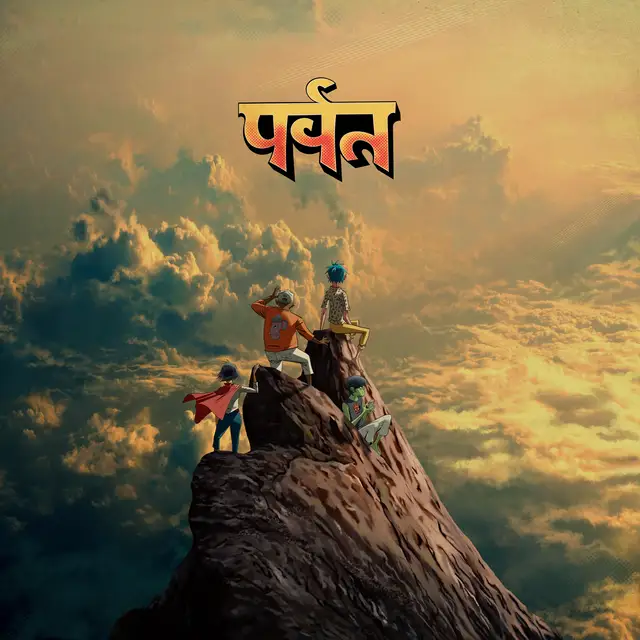
Gorillaz - The Mountain
The strongest case in years that Gorillaz can still make records that matter as records.
The first thing to say about Gorillaz’s ninth album is that, at a time when every major release arrives pre-fragmented into “moments”, 'The Mountain' behaves with mildly irritating confidence as an actual album. Not content, not a vibe board, not 14 disconnected playlist bids and one mandatory “intimate” closer. An album. This is either admirable or inconvenient, depending on whether you enjoy being told to sit still for an hour by Damon Albarn.
Still, there are worse ways to spend that hour. Gorillaz have always worked best when Albarn and Jamie Hewlett give themselves a firm conceptual rail to run on; without one, the project can tip into a very expensive cupboard full of good ideas. Here, it's grief, legacy and mortality, framed by the attempt to make peace with all three without lapsing into self-pity or New Age paste. What matters is that you can hear it in the record’s architecture. It sounds intentional in a way some latter-day Gorillaz records did not.
Musically, 'The Mountain' is expansive without being directionless. Sitar and flute lines are worked into the bloodstream of the songs rather than dropped in as atmospheric postcards. The title-track opens the doors in widescreen fashion and sets the tone: contemplative and strangely warm. It doesn’t announce itself with a giant single-sized haymaker, which is probably why it works as an opener. It invites you into the world rather than shouting over it.
That world is crowded because this is Gorillaz, and crowding is part of the brand identity. That mostly serves the songs rather than dominating them, though. 'The Moon Cave' has buoyancy without feeling flimsy, while 'The Happy Dictator' turns cynicism into catchy pop theatre. 'Damascus' adds kinetic voltage at exactly the point the record risks going stale. And then there’s 'The Manifesto', the seven-minute centrepiece that could have collapsed under the weight of its own ambition but, against the odds, becomes one of the album’s best arguments for itself: restless, bold, and emotionally charged without pretending subtlety it doesn’t have.
The archival voices are the album’s most delicate gamble. Bringing in posthumous contributions can feel ghoulish in lesser hands. Here, it’s more complicated and more effective. These appearances are memory not as nostalgia, but as ongoing presence. The effect is often moving, occasionally uncanny, and generally more thoughtful than the cynics would predict.
None of this means 'The Mountain' is flawless, because it isn’t. For all its coherence, it does meander. There are stretches where momentum slows. Albarn has always had a certain weakness for lines that sound profound at 2am and less so in the cold light of the next morning. What 'The Mountain' gets absolutely right, though, is tonal balance. For an album preoccupied with death, it isn’t grim. You get satire beside sorrow, propulsion beside contemplation, and emotional specificity beside broad-stroke mythmaking. That balancing act is not new territory for Gorillaz, but it feels newly purposeful here.
Which leaves the obvious question: is this a late-career peak? Perhaps not in the blunt, era-defining way of 'Demon Days' or 'Plastic Beach'. But it is the strongest case in years that Gorillaz can still make records that matter as records. 'The Mountain' is uneven, overfull, occasionally exasperating, and frequently excellent. It carries itself with grace, its ideas with conviction, and its excess with just enough charm to get away with most of it. And at this stage of the project’s life, that counts as something close to a triumph.
Get more Dork

Sessions · Playlists · Behind the scenes